Introduction
Pin header connector series are some of the most widely used interconnects in electronics, yet they are often overlooked during design. From industrial controllers and consumer devices to networking and telecom equipment, pin headers and matching female sockets quietly provide the critical board-to-board and wire-to-board connections that keep systems running.
A well-designed pin header connector series does much more than simply bring signals out of the PCB. It has to support different orientations, stacking heights, pitches, currents and plating options, while remaining cost-effective and easy to assemble. In this article, we’ll walk through the key elements of a modern pin header connector series, the main product options you can choose from, and practical tips to help you select the right solution for your next design.
What Is a Pin Header Connector Series?
A pin header connector series is a family of compatible headers and receptacles that use rectangular housings with rows of plated pins or sockets. By combining male headers with matching female headers, designers can create low-profile, modular interconnects between PCBs, cables and daughtercards.
Typical characteristics of a pin header connector series include:
- Single, dual or multiple rows of contacts
- Standard pitches for global compatibility
- Vertical and right-angle mounting options
- Through-hole or SMT terminations
- Choice of gold or tin plating for performance and cost balance
Because the family is designed as a series, you can mix and match part numbers to cover different pin counts, heights and orientations with a consistent look, feel and footprint.
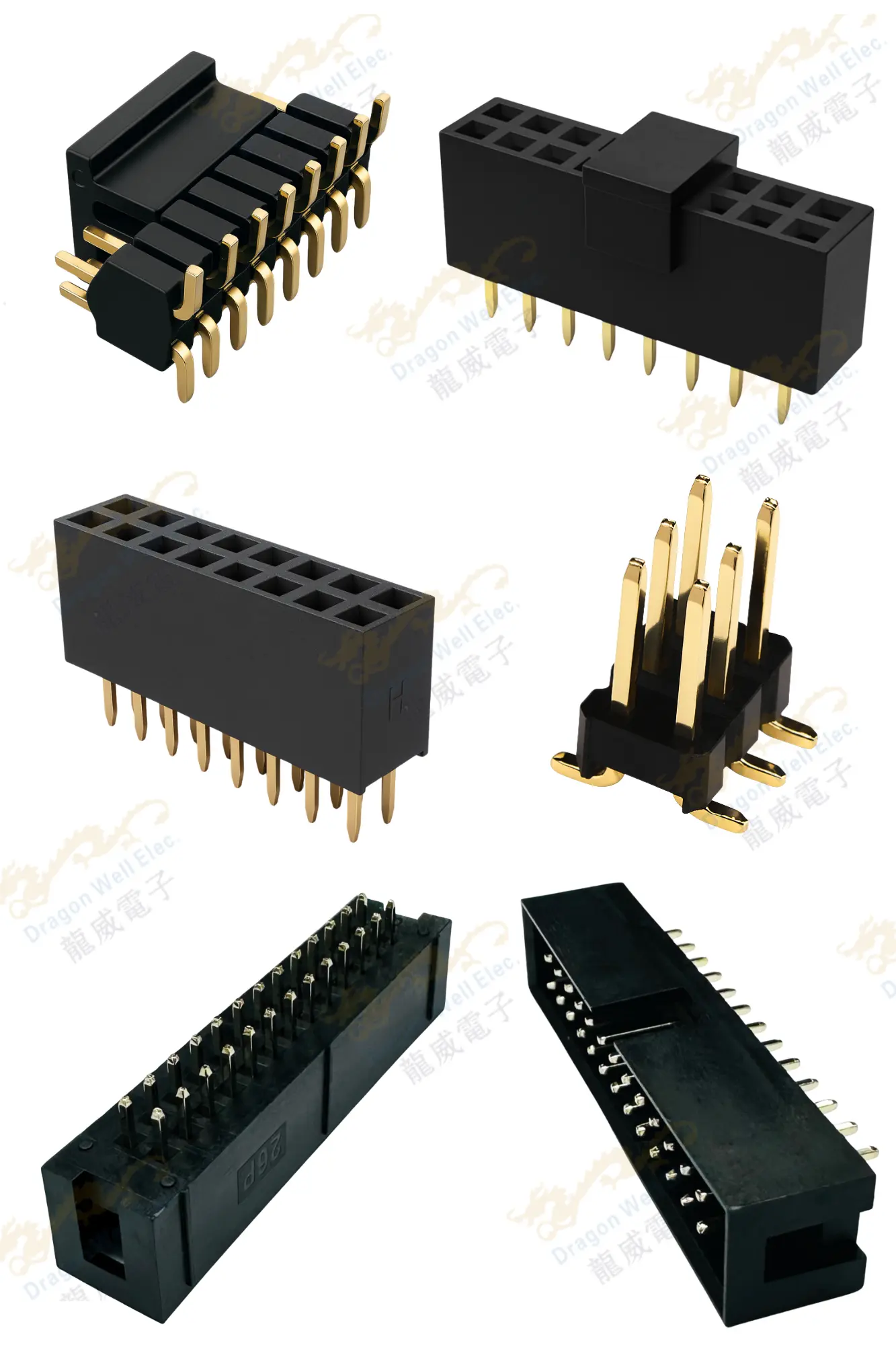
9 Core Products in a Complete Pin Header Connector Series
The image above shows examples of the building blocks in a comprehensive pin header connector series. Let’s break them into nine core product types.
1. Straight (Vertical) Pin Headers
Straight through-hole headers are the classic solution for connecting a daughterboard or cable harness perpendicular to the PCB. They are ideal when you want simple assembly, strong solder joints and easy probing during test and debug. In a pin header connector series, these vertical headers are usually available in a wide range of pin counts and row options to cover multiple boards with the same footprint.
2. Right-Angle Pin Headers
Right-angle headers route signals parallel to the PCB surface, which is perfect for edge connections, low-profile enclosures or when you need the mating connector to sit horizontal to the board. A robust pin header connector series will offer right-angle versions for the same pitch and pin count as the vertical headers so you can change mechanical layout without redesigning your schematics.
3. Single-Row Female Headers
Single-row female headers mate with male pin strips to form simple board-to-board or board-to-cable links. They can be used as removable jumpers, programming interfaces or low-pin-count board connectors. In your pin header connector series, single-row females should share the same pitch and contact geometry as the male parts for perfect mating.
4. Dual-Row and Multi-Row Female Headers
For higher pin density, dual-row and multi-row female sockets bring more contacts into the same footprint. These are widely used in microcontroller boards, communication modules and stackable embedded platforms. A flexible pin header connector series will let you choose the number of rows and pin heights to balance density, creepage distance and ease of assembly.
5. Elevated and Low-Profile Stack Headers
Some applications need extra space between boards for tall components or airflow. Elevated headers – sometimes called stack headers – extend the pin length or move the insulator body to create specific stacking heights. Conversely, low-profile headers minimize the z-height for compact devices. Modern pin header connector series provide multiple stack heights so you can tune spacing without custom tooling.
6. SMT Pin Headers
Surface-mount headers enable automated pick-and-place assembly and are ideal for high-volume production. They are often used in compact consumer and networking equipment where every square millimeter counts. A good pin header connector series will include SMT versions of key pin counts and row counts so that your layout can benefit from full SMT processing.
7. Shrouded and Polarized Headers
Shrouded headers add plastic walls and polarization keys around the pins to prevent mis-mating and to improve strain relief. When combined with locking ramps or latches on the cable side, they create robust wire-to-board interconnects. Including shrouded parts in your pin header connector series means you can standardize on one footprint for both serviceable and production assemblies.
8. High-Current and Gold-Plated Headers
Applications carrying more current or operating in harsh environments benefit from thicker copper, wider pins or enhanced plating. Gold-plated contacts improve corrosion resistance and mating reliability, especially in low-level signal circuits. Within a pin header connector series, high-current or high-reliability options let you upgrade performance while preserving the same PCB layout.
9. Customized and Breakaway Header Strips
Finally, many engineers rely on breakaway header strips that can be cut to custom lengths, or on semi-custom configurations with special pin lengths, mixed row counts or board locks. A versatile pin header connector series will support these needs with configurable strips and engineering support, so you can fine-tune your header solution without starting from scratch.
Key Design Features of a High-Quality Pin Header Connector Series
When evaluating different pin header connector series, look beyond just pin count and price. Several design details have a big impact on long-term performance.
Contact System and Plating
The geometry of the contact and the plating thickness determine the connector’s electrical performance and durability. Square or rectangular posts with controlled tolerances ensure consistent mating with socket contacts. Gold over nickel plating provides excellent corrosion resistance for low-level signals, while tin plating offers a cost-effective choice for many power and general-purpose applications.
Pitch and Layout Flexibility
A strong pin header connector series should cover the pitch options you use most often across your product lines. Support for common footprints lets you share PCB libraries and reuse proven layouts across multiple projects. Flexible row counts and stacking heights reduce the need for custom designs.
Termination and Assembly Options
Through-hole terminations still dominate in applications where mechanical strength matters or where rework and manual assembly are common. SMT terminations are preferred in dense or high-volume designs. When your pin header connector series offers both, you can optimize each product for its manufacturing process while keeping signal assignments and pinouts consistent.
Mechanical Retention and Polarization
Features such as board locks, friction ribs, mounting pegs and shrouds prevent the connector from shifting during soldering or service. Polarization keys and chamfered entries help operators and customers mate the connectors correctly the first time. Choosing a pin header connector series with these options can reduce field failures and assembly defects.
Typical Applications for Pin Header Connector Series
Because they are simple, modular and affordable, pin header connector series show up in almost every electronics segment:
- Embedded control boards and development kits
- Industrial automation and PLC modules
- Telecom, networking and data-center equipment
- Consumer electronics and smart home devices
- Measurement, medical and test instruments
- Power supplies and battery management systems
In many of these designs, pin header connector series are paired with ribbon cable connectors, IDC sockets or board-stacking mezzanine connectors from global suppliers such as Amphenol Socapex, Molex and Samtec, giving engineers a complete connectivity ecosystem.
How to Choose the Right Pin Header Connector Series for Your Design
When selecting a pin header connector series for a new project, consider these questions:
- Signal type and current level – Are you carrying low-level signals, power rails, or a mix? This informs pin size and plating choice.
- Mechanical orientation – Do you need vertical or right-angle mating? Is the connection meant for stacking boards or for bringing signals to a panel or edge?
- Assembly process – Will your boards be assembled with full SMT, mixed technology, or manual soldering? Pick through-hole or SMT styles to match.
- Required lifetime – Estimate how many mating cycles the connector will experience. Development kits, test fixtures and plug-in modules may require more robust plating and socket designs.
- Environmental conditions – Consider temperature range, vibration, shock and possible contamination from dust or chemicals. Materials and contact systems should be rated accordingly.
- Standardization – Whenever possible, standardize on a single pin header connector series across multiple platforms. This simplifies purchasing, reduces inventory and speeds up design.
Best Practices for Integrating Pin Header Connector Series into Your PCB
To get the most from your chosen pin header connector series, keep these implementation tips in mind:
- Follow the recommended pad layout and drill sizes from the connector’s datasheet. Small deviations can affect solder quality and mating alignment.
- Maintain adequate creepage and clearance between rows and adjacent circuitry, especially when carrying higher voltages.
- Plan for test and rework by ensuring there is enough space around the connectors for probes, rework tools and inspection cameras.
- Use proper strain relief for any mating cable or daughterboard, such as standoffs, enclosures or mechanical fasteners, so the connector isn’t bearing all the stress.
- Document pin assignments clearly in your schematics, silkscreen and assembly drawings to avoid wiring errors.
Why Partner with Dragon Well for Your Pin Header Connector Series
Choosing the right pin header connector series is easier when you work with a supplier that understands both cost-sensitive volume production and demanding high-reliability applications. Dragon Well Electronics offers a broad range of vertical and right-angle headers, gold-plated and tin-plated options, and matching female sockets designed to streamline your board-to-board and wire-to-board interfaces.
Our engineering team can help you match pin header connector series parts to your existing footprints, optimize plating and pin lengths for your environment, and recommend compatible sockets or cable assemblies.
Order & RFQ
Need samples or a cost-down cross-reference for your pin header connector series project? Share your BOM or drawing and we’ll match plating and packing codes 1:1.
- Websites: cndragonwell.com | dw-tek.com
- Email: prothick@cndragonwell.com
Connect with Us
Stay up to date with new pin header connector series releases, automotive and industrial solutions, and application notes: