What Are USB Type-C Connectors?
USB Type-C connectors are modern, reversible interface connectors used for data, charging, and (in many devices) video and high-speed protocols. Compared to older USB formats, the Type-C design supports a compact footprint, easier user insertion, and a broad range of performance options—from USB 2.0 all the way to USB 3.2 and USB4 (up to 40Gb/s), plus higher-current charging designs that can reach up to 10A options depending on configuration and application.
Because Type-C can be implemented in different ways, choosing the right USB Type-C connector series is critical for product reliability, compliance, and long-term durability.
Quick Overview of USB Type-C Connector Series (USB2.0–USB4, 40Gb/s, 10A)
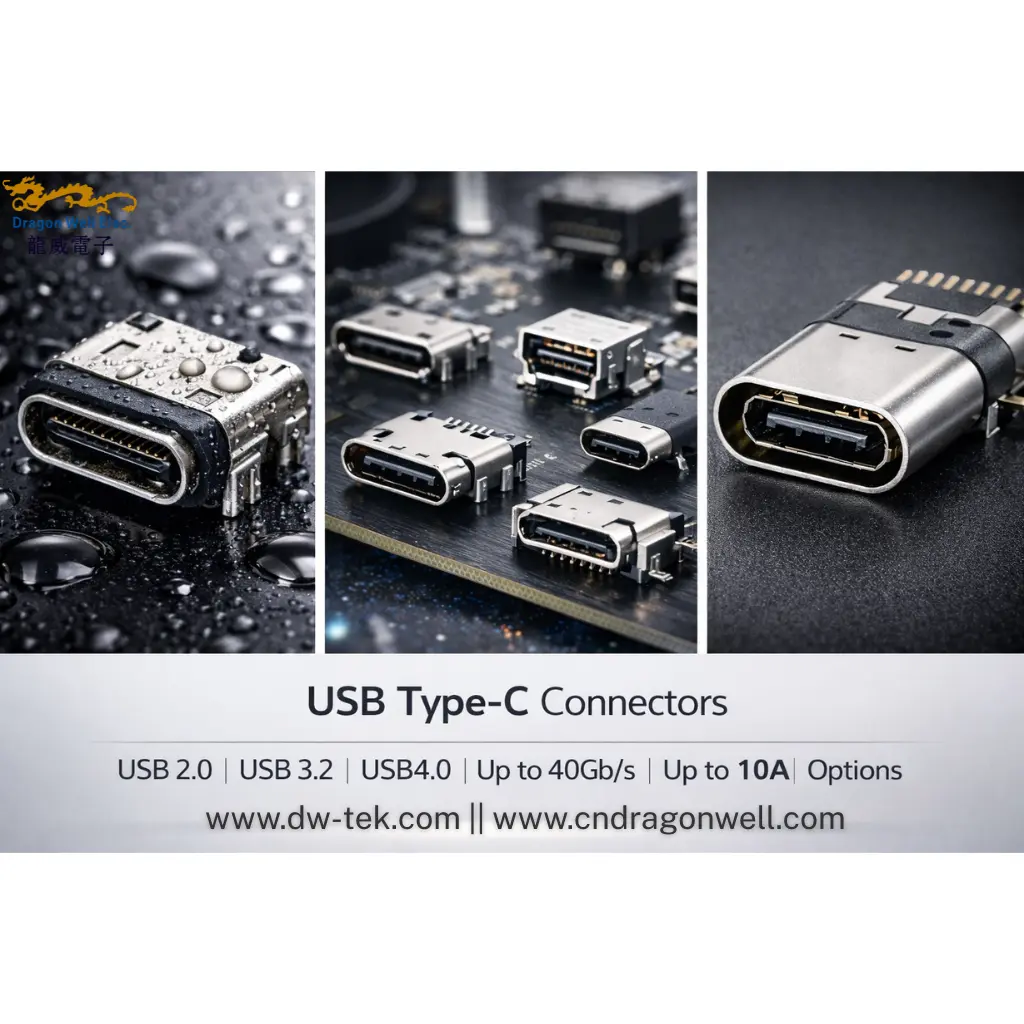
Your image highlights key positioning for a Type-C lineup: USB 2.0 | USB 3.2 | USB4.0 | up to 40Gb/s | up to 10A options. Here’s what that means in a practical selection view:
USB 2.0 Type-C (Cost-Optimized for Charging + Basic Data)
Best for: power input, basic data devices, simple peripherals
Why: fewer high-speed requirements, simpler routing
USB 3.2 Type-C (Higher-Speed Data)
Best for: docks, storage devices, higher-speed peripherals
Why: supports faster transfer rates than USB 2.0 designs
USB4 Type-C (Up to 40Gb/s Class)
Best for: premium devices, high-performance docks, advanced connectivity
Why: enables very high data rates and demands tighter design control
Up to 10A Options (High Current Designs)
Best for: high-power charging systems and robust power delivery designs
Why: requires careful contact design, temperature considerations, and system-level planning
This is why “Type-C” alone is not enough. The right USB Type-C connectors choice depends on your true performance target.
9 Essential Tips to Choose the Right USB Type-C Connectors
1) Decide your real requirement first: USB 2.0, USB 3.2, or USB4
Before selecting a part, confirm what your product must support:
- USB 2.0 for basic data + charging
- USB 3.2 for faster data devices
- USB4 for premium high-speed (up to 40Gb/s class)
Choosing the correct performance tier is the foundation of selecting the right USB Type-C connectors.
2) Confirm whether your Type-C port is power-in, power-out, or both
Some products only need charging input. Others must provide power out to accessories. Power direction changes requirements for durability, thermal behavior, and long-term reliability.
3) Check current rating targets (including up to 10A options)
If your product needs higher current, do not assume any Type-C will work. Higher-current 10A USB Type-C connector options require:
- stable contact design
- good heat performance
- correct PCB and mechanical support
4) Choose the right mounting style for your mechanical design
Common choices include SMT, hybrid, and through-hole reinforcement styles. A port that receives frequent plugging needs strong mechanical retention so it doesn’t loosen over time.
5) Select shielding and grounding strategy based on environment
In industrial or noisy environments, shielding becomes more important. A good Type-C selection includes grounding points and a clean mechanical fit to reduce EMI problems.
6) Think about insertion cycles and durability
Many Type-C ports are used multiple times per day. Durability depends on:
- plating choice
- contact force stability
- shell strength and retention tabs
A robust USB Type-C connector series should match your expected usage level.
7) Plan PCB routing early for USB 3.2 / USB4 designs
Higher speeds require better routing discipline. If your target is USB 3.2 or USB4, your connector selection should happen early so the footprint, differential pair routing, and layout constraints are designed correctly from the start.
8) Consider waterproof or rugged options if exposure is possible
Your image shows a water/condensation style visual on one connector. If your product faces moisture, outdoor use, or industrial exposure, consider:
- sealed or rugged connector variants
- protective mechanical structures in enclosure design
9) Ensure production consistency and sourcing stability
For volume manufacturing, the most common failure isn’t the spec—it’s inconsistency. Choose USB Type-C connectors that are stable in production with repeatable quality and reliable supply.
Example Scenarios: Which USB Type-C Connector Series Fits Best
Consumer Electronics Charging Port
Recommended: USB 2.0 Type-C series
Why: reliable charging + basic data at cost-effective design
Docking Station or High-Speed External Storage
Recommended: USB 3.2 Type-C series
Why: higher data performance and better user experience
Premium Laptop / Advanced Hub Platform
Recommended: USB4 Type-C connector series (40Gb/s class)
Why: maximum performance for premium connectivity
Industrial Device with High Current Requirement
Recommended: 10A USB Type-C connector option (with mechanical reinforcement)
Why: power stability and long-term durability under load
Why Work with Dragon Well for USB Type-C Connectivity
Global connector ecosystems define the Type-C landscape, and real product reliability comes from correct connector choice and consistent manufacturing. Dragon Well Electronics supports USB Type-C connectors and related connectivity components for OEM and manufacturing needs.
How we support Type-C projects:
- USB Type-C connector series options (USB 2.0 / USB 3.2 / USB4 design targets)
- high-current solutions (up to 10A options depending on design)
- stable mechanical designs for repeated insertion
- cross-reference support for packaging and production requirements
Internal links to add (your website pages):
- USB Type-C connectors category page
- USB connectors category page
- Board-to-board / headers category page (for internal assemblies)
Order & RFQ
Need a recommendation for the right USB Type-C connectors series based on your board layout and power requirement? Share your drawing or PCB constraints and we’ll suggest matching options.
Websites: cndragonwell.com | dw-tek.com
Email: prothick@cndragonwell.com
Connect with Us
LinkedIn: https://www.linkedin.com/company/dragon-well-electronics-co-ltd
Instagram: https://www.instagram.com/dragonwell_electronics
Facebook: https://www.facebook.com/DragonWellElectronics