Introduction
OBDII connector series are the silent heroes behind fast and accurate vehicle diagnostics. Every time a technician plugs in a scan tool, a data logger, or a telematics device, these compact connectors create the critical data and power pathway between the car’s ECU and the test equipment. A well-designed OBDII connector series doesn’t just carry signals – it protects your electronics, speeds up service time, and keeps vehicles safely on the road.
From OEM production lines to aftermarket garages and fleet depots, demand for robust OBDII connector series is growing quickly. Engineers are under pressure to design compact, rugged and cost-effective diagnostic interfaces that still meet global standards and withstand harsh automotive environments. In this article we’ll explore what makes a high-performance OBDII connector series, the main configurations available, and how to select the right solution for your next project.
What Is an OBDII Connector and Why It Matters
On-board diagnostics (OBDII) is the standardized system used in modern vehicles to monitor emissions-related functions and many critical subsystems. The OBDII connector is the 16-pin interface – usually located beneath the steering column – that allows external tools to read and clear diagnostic trouble codes, stream live data and even reprogram certain modules.
Because the OBDII interface is standardized, any compliant scan tool can plug into any compliant vehicle. However, not all OBDII connector series are created equal. Differences in contact design, plating quality, plastics and retention features have a huge influence on long-term performance. A premium OBDII connector series delivers:
- Consistent low-resistance contacts for clean data signals
- Reliable mating after thousands of insertion cycles
- High vibration and shock resistance for tough on-road conditions
- Secure latching so plugs don’t work loose during testing
- Easy integration onto PCBs, harnesses or adapter boards
When your design calls for repeatable, long-term diagnostic access, investing in the right OBDII connector series is essential.
The 7 Core Products in a Complete OBDII Connector Series
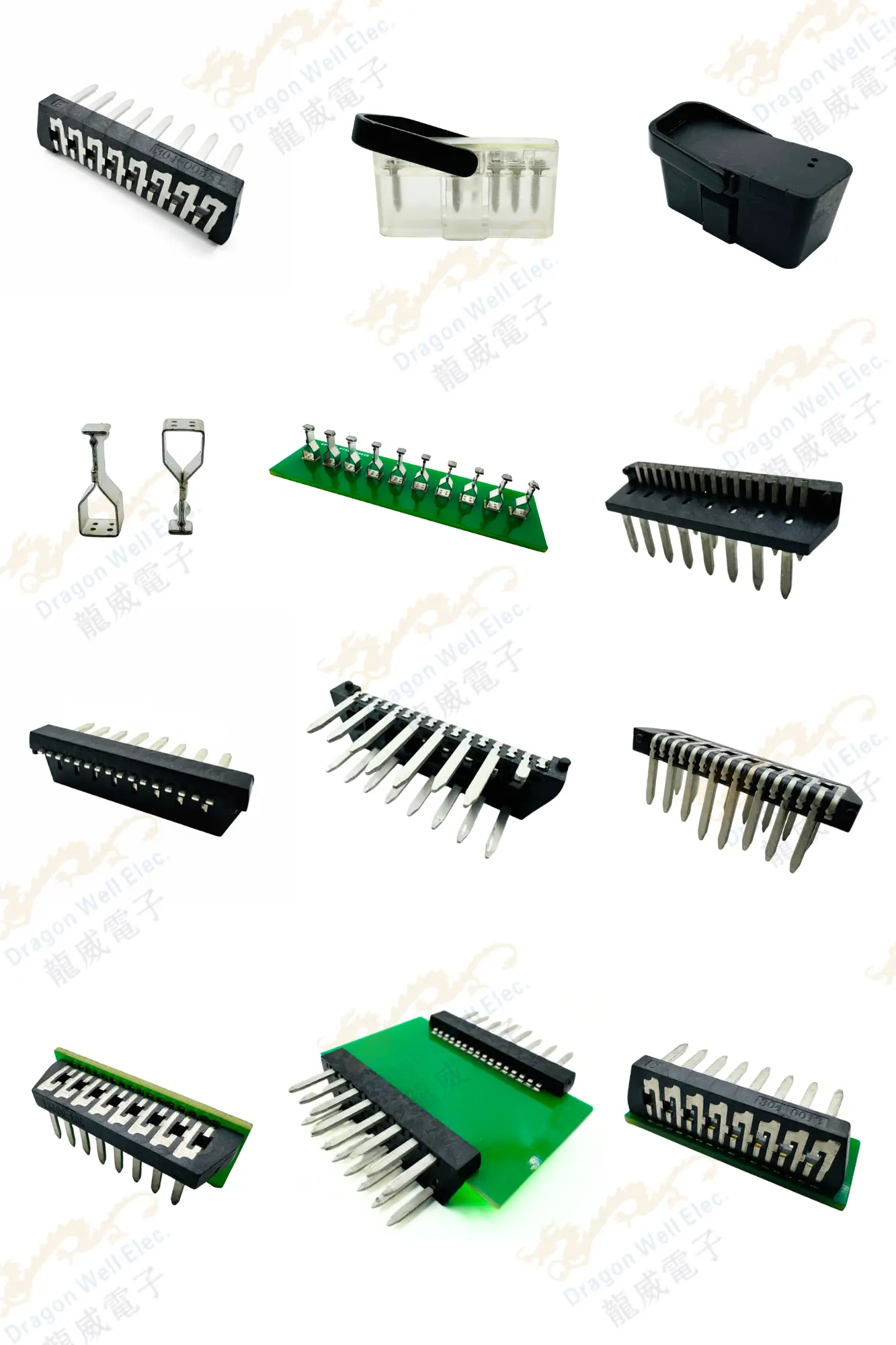
To cover all typical automotive and test-equipment needs, a complete OBDII connector series usually includes several complementary parts. The image above shows examples of these building blocks.
1. Right-Angle PCB Header
Right-angle PCB headers allow the OBDII port to exit horizontally from a control board or small module. They’re ideal for compact diagnostic tools or dongles that plug directly into the vehicle. Good headers in an OBDII connector series use reinforced solder tails, robust housing ribs, and polarization features to prevent mismating.
2. Vertical PCB Header
Vertical headers point straight up from the PCB, simplifying routing for some enclosures and adapter boards. When used in an OBDII connector series, vertical versions often share the same footprint as right-angle headers so designers can switch orientation without redesigning the board.
3. Wire-to-Wire Plug Housing
Wire-to-wire OBDII plug housings create the male side of the interface for cable assemblies. They’re commonly used on handheld scan tools, custom harnesses and extension cables. A rugged OBDII connector series will support a wide range of wire gauges, proven strain-relief features and optional backshells or overmolding.
4. Receptacle Housing and Panel-Mount Options
On the vehicle side, panel-mount receptacles in the OBDII connector series provide a stable interface for repeated plug-in events. Reinforced mounting ears and anti-rotation features help maintain alignment with interior trim panels, while locking ramps hold the mating plug firmly in place.
5. Protective Caps and Covers
Dust, moisture and debris are enemies of any connector. Protective caps and covers are therefore a key part of an OBDII connector series designed for long life in real vehicles. They protect unused ports during production, shipping and daily use, and many designs feature tethers so the cap cannot be lost.
6. Solder-Tail and Terminal Variants
For engineers building custom adapter boards or service fixtures, individual terminals and solder-tail options provide extra design flexibility. These elements in an OBDII connector series enable special pin configurations, test boards or break-out modules for engineering development and validation.
7. Breakout Boards and Adapter Modules
Finally, some OBD2 connector series add ready-made breakout boards or adapter modules. These simplify lab work by bringing each pin of the OBD2 interface to easy-to-probe test points or alternative connectors. They save engineers significant development time during prototyping and can also be used in training and education environments.
Typical Applications for an OBDII Connector Series
anks to its versatility, an OBDII connector series supports a wide range of applications beyond standard workshop diagnostics:
- Handheld scan tools and code readers
- Telematics and GPS tracking devices for fleets
- Insurance black-box units and usage-based insurance (UBI)
- Data loggers for vehicle development and motorsport
- Emission-testing stations and inspection equipment
- Electric vehicle (EV) battery and charger monitoring systems
Wherever reliable access to vehicle data is needed, a durable OBDII connector series becomes a strategic component choice.
Why Partner with a Specialist for our OBDII Connector Series
Working with a supplier focused on automotive connectors means you benefit from proven designs, reliable supply chains and engineering support. A dedicated manufacturer can help you:
- Tailor an OBDII connector series to your exact pinout or housing geometry
- Integrate the connectors with fully assembled harnesses and overmolded cables
- Meet tight project timelines with existing tools and validated platforms
- Navigate qualification, testing and documentation for demanding OEM customers
Whether you’re designing a compact Bluetooth dongle, a rugged fleet logger or a new OEM diagnostic interface, choosing a well-engineered OBDII connector series is one of the simplest ways to boost reliability, reduce warranty costs and deliver a better user experience.
Call to Action
Ready to upgrade your next project with a robust OBDII connector series?
Explore our full range of OBDII headers, housings, caps and breakout solutions, or contact our engineering team for customized support on pinouts, PCB footprints and cable assemblies. Together we can build diagnostic interfaces that keep you connected to every vehicle on the road.
Order & RFQ
Need samples or a cost-down cross-reference for your OBDII connector series project? Share your BOM or drawing, and we’ll match plating and packing codes 1:1
- Websites: cndragonwell.com || dw-tek.com
- Email: prothick@cndragonwell.com
Connect with Us
Stay up to date with new OBDII connector series releases, automotive solutions and application notes:
Facebook: https://www.facebook.com/DragonWellElectronics
LinkedIn: https://www.linkedin.com/company/dragon-well-electronics-co-ltd