I/O connectors are widely used in modern electronic equipment to create reliable interfaces between devices, printed circuit boards, cables, and external systems. From consumer electronics and displays to embedded systems and industrial equipment, these connectors help support stable electrical connections in many applications.
For engineers, purchasing teams, OEMs, and ODM companies, selecting the right connector involves more than simply matching the appearance. Mounting style, connector dimensions, PCB layout, contact structure, electrical requirements, and application conditions should all be considered.
A suitable I/O connector can help simplify product design, improve connection stability, and provide the mounting flexibility required for different electronic equipment.
What Are I/O Connectors?
I/O connectors, or input/output connectors, provide an electrical and mechanical interface between electronic equipment and another device, cable, board, or system.
Depending on the application, these connectors may be mounted directly to a PCB, installed through a panel, or positioned for side-entry connections.
Common configurations include:
Board-mount connectors, Panel-mount connectors, Right-angle connectors, Vertical connectors, Side-entry connectors, Shielded connectors, Custom interface connectors
Different configurations allow engineers to choose a connector according to available PCB space, enclosure structure, mating direction, and equipment requirements.
Why I/O Connector Selection Matters
Although a connector may be a small part of an electronic product, it can have an important effect on the overall interface performance.
A connector that does not properly match the PCB or enclosure may create problems during assembly, mating, or installation.
For this reason, I/O connectors should be evaluated based on the complete application rather than only price or appearance.
For sourcing teams, supplier capability is also important. Technical support, drawing review, samples, production consistency, and custom development can all help when evaluating an existing or alternative connector source.
7 Essential Factors When Choosing I/O Connectors
1. Confirm the Mounting Style
First, determine how the connector needs to be installed.
Common options include: Board mount, Panel mount, Surface mount, Through-hole mounting, Right-angle mounting, Vertical mounting, Side-entry mounting
The mounting style should match both the PCB layout and the mechanical design of the equipment.
2. Check Connector Dimensions
Modern electronic equipment often has limited internal space.
Before choosing I/O connectors, check the connector height, width, depth, mounting position, and mating space.
A compact board-mount connector may be suitable for high-density PCB layouts, while a panel-mount solution can be useful when the interface needs to remain accessible from outside the equipment.
3. Verify PCB Compatibility
The connector must fit the intended PCB layout correctly.
Important points can include: PCB footprint, Terminal arrangement, Mounting holes, Mounting tabs, Board locks, Connector orientation, SMT or through-hole termination
Small mechanical differences can prevent an alternative connector from fitting an existing board.
Providing the existing part number or engineering drawing can make connector matching more accurate.
4. Compare Electrical Requirements
Electrical specifications should always match the actual application.
Depending on the connector, buyers may need to review: Current rating, Voltage rating, Contact resistance, Insulation resistance, Withstanding voltage, Signal requirements
These specifications should be confirmed from the drawing or technical information for the exact connector being evaluated.
5. Review Mechanical Stability
Some I/O connectors experience repeated mating and unmating throughout the life of the product.
Mounting tabs, board locks, metal shells, panel structures, and other reinforcement features can help provide a stable interface.
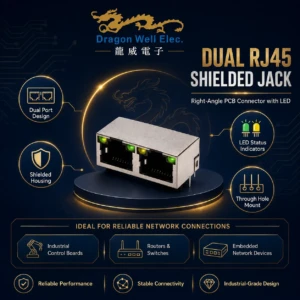
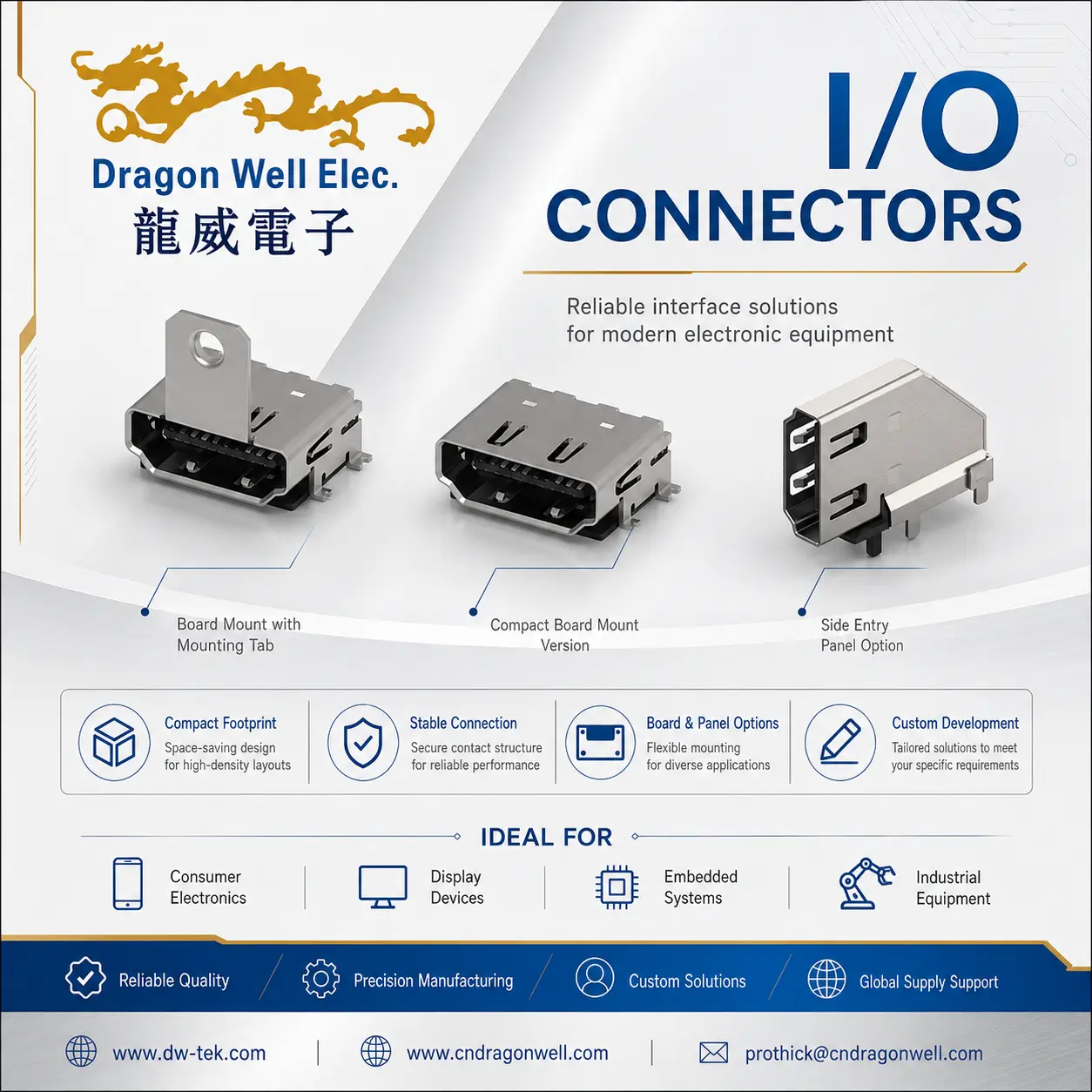
The connector designs shown in the featured image include board-mount, compact board-mount, and side-entry configurations for different installation requirements.
6. Consider the Application
Different electronic products have different connector requirements.
Common applications include:
Consumer electronics
Display devices
Embedded systems
Industrial equipment
Communication equipment
Control systems
Compact electronic devices
Consumer products may prioritize compact size, while industrial equipment may require stronger mounting and dependable long-term operation.
7. Check Custom Development Support
Standard connectors cannot meet every project requirement.
OEM and ODM customers may require changes related to connector dimensions, mounting structures, materials, contact arrangements, or other mechanical requirements.
A supplier with custom development capability can review the project and determine whether an existing connector or customized solution is more suitable.
Common Applications of I/O Connectors
The flexible design of I/O connectors makes them suitable for many electronic products.
Consumer Electronics
Consumer devices often require compact connectors that provide reliable external interfaces without occupying excessive PCB or enclosure space.
Display Devices
Display equipment may require connectors for communication, signals, peripheral devices, or control interfaces.
The correct connector depends on the enclosure design, PCB position, and mating direction.
Embedded Systems
Embedded controllers and compact systems often require dependable connections between the main PCB and external equipment.
Compact I/O connectors can help support these interfaces where board space is limited.
Industrial Equipment
Industrial controllers, machines, communication devices, and other equipment may require connectors with secure mounting structures and stable contact performance.
How to Choose the Right I/O Connector
Choosing the correct I/O connector begins with understanding the application.
First, confirm whether the connector needs board mounting, panel mounting, or another installation method.
Next, review the dimensions, mating direction, PCB footprint, and mounting structure.
Then compare the required electrical specifications and operating conditions.
If you are looking for an alternative to an existing connector, sending the original part number, drawing, PCB information, or application requirements is usually the most effective starting point.
Why Connector Quality Matters
A reliable electronic interface depends on consistent connector manufacturing.
Terminal positioning, housing dimensions, contact structure, material selection, plating, and mounting accuracy can all influence connection performance.
For OEM and ODM production, consistency is especially important when the same I/O connectors are used across large production quantities.
A dependable supplier should therefore support both technical compatibility and stable manufacturing quality.
Why Consider Dragon Well Electronics as an I/O Connector Supplier?
Dragon Well Electronics supports connector solutions for consumer electronics, displays, embedded systems, industrial equipment, and other electronic applications.
For I/O connector projects, Dragon Well can support:
Board-mount connector solutions
Panel and side-entry options
Existing part-number matching
Engineering drawing review
Sample support
Custom connector development
OEM and ODM projects
Production support
Global supply support
For sourcing teams evaluating an alternative I/O connector manufacturer, Dragon Well can review an existing part number, drawing, or requirement and help determine whether a standard or customized connector solution is suitable.
Rather than evaluating an alternative only by price, buyers can provide the existing connector information for technical comparison first.
Order and RFQ
Need I/O connectors, an alternative connector source, or support matching an existing interface connector?
Please share your current part number, engineering drawing, PCB requirements, mounting style, application, required specifications, and estimated quantity for evaluation.
Dragon Well Electronics can review the requirement and help identify a suitable standard or customized connector solution.
Websites:
www.dw-tek.com
www.cndragonwell.com
Email:
prothick@cndragonwell.com || info@dw-tek.com
Connect with Us
LinkedIn: Dragon Well Electronics Co., Ltd.
Instagram: Dragon Well Electronics
Facebook: Dragon Well Electronics