Pin Headers & Female Headers are among the most practical and widely used connector solutions in PCB module design. They provide a simple way to connect printed circuit boards, daughterboards, sensor modules, development boards, control boards, display modules, and other electronic assemblies.
In modern electronics manufacturing, engineers often need connectors that are reliable, easy to assemble, flexible in layout, and suitable for both prototype and mass production. This is why Pin Headers & Female Headers remain important in consumer electronics, industrial control, communication devices, automotive electronics, power modules, and embedded systems.
Although these connectors may look simple, their role in PCB design is important. The right header connector can improve assembly efficiency, simplify maintenance, support modular product design, and help manufacturers build stable electrical connections between boards.
What Are Pin Headers & Female Headers?
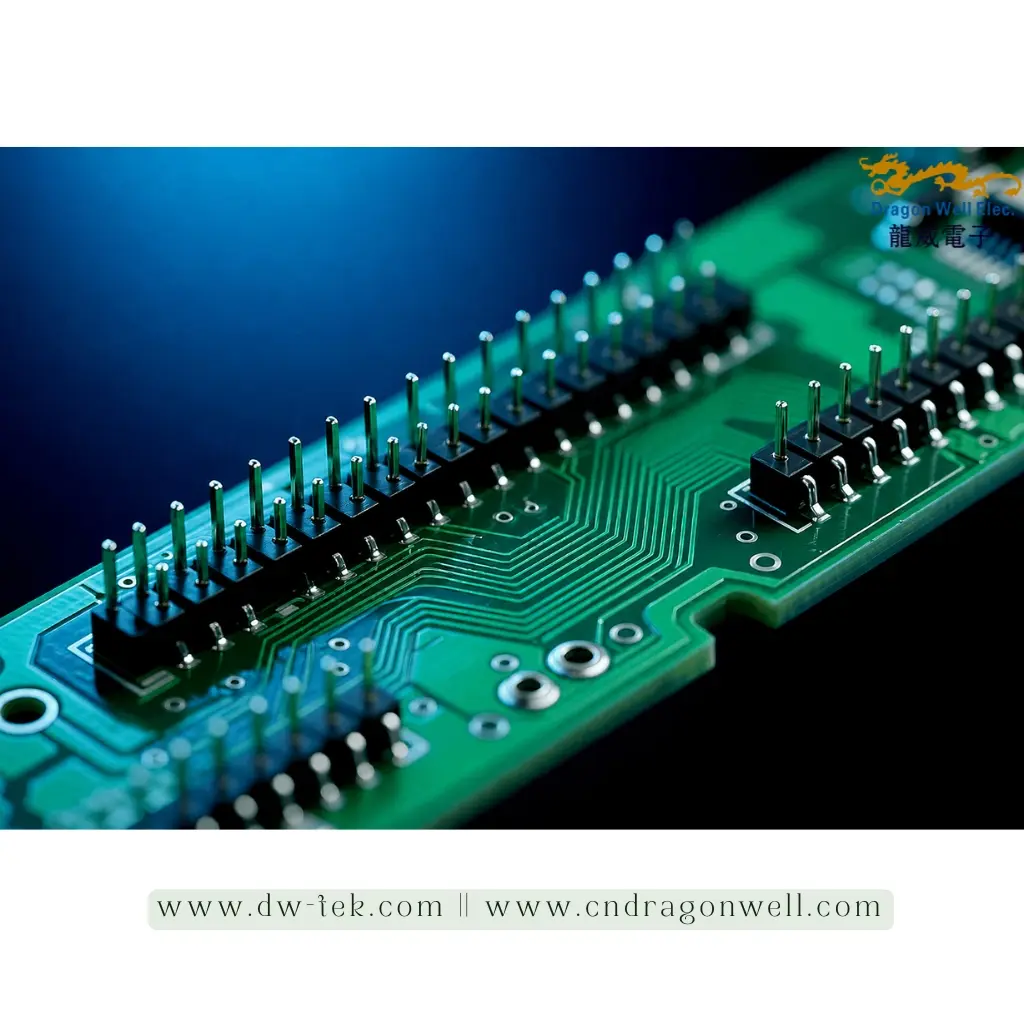
Pin Headers & Female Headers are board-level connectors used to create electrical and mechanical connections between PCB assemblies. A pin header usually has exposed metal pins, while a female header has matching socket contacts that receive the pins.
When mated together, they create a removable or semi-permanent connection between two boards or between a PCB and another electronic module. This makes them useful for board-to-board connections, wire-to-board interfaces, test points, programming ports, and modular electronics.
Pin headers are commonly available in single-row, dual-row, straight, right-angle, surface-mount, and through-hole configurations. Female headers are also available in different pitch sizes, contact lengths, housing heights, and mounting styles depending on the product design.
Why Pin Headers & Female Headers Matter in PCB Modules
Pin Headers & Female Headers matter because PCB modules often need flexible interconnection. Instead of permanently soldering one board directly to another, engineers can use header connectors to make the system easier to assemble, test, replace, and upgrade.
For example, a control board may need to connect with a display module, sensor module, communication module, or power board. Using a header connector allows the design to stay modular. This can reduce production complexity and improve long-term maintenance.
In OEM and ODM electronics projects, connector selection affects more than the PCB layout. It can influence production speed, product reliability, repair convenience, packaging structure, and user experience. A poor connector choice may create loose contact, alignment problems, unstable signals, or assembly failure.
7 Powerful Advantages of Pin Headers & Female Headers
1. Simple and Reliable Board-to-Board Connection
One major advantage of Pin Headers & Female Headers is their simple board-to-board connection structure. Engineers can connect two PCB modules without complex wiring or custom mechanical parts.
This simplicity makes them especially useful in compact electronic devices, prototype boards, development kits, and modular control systems. A clear pin-to-socket connection also helps reduce assembly confusion during production.
2. Flexible PCB Module Design
Modern electronic products often use modular architecture. A main board may connect to several smaller boards for display, communication, sensing, control, or power management.
Pin Headers & Female Headers support this modular design approach. Engineers can separate functions into different boards and connect them through matching headers. This helps with layout flexibility, design updates, and product customization.
For manufacturers, modular design can also reduce development time because one PCB module can be reused across several product models.
3. Cost-Effective Connector Solution
Compared with many complex connector systems, Pin Headers & Female Headers are often a cost-effective option for PCB interconnection. Their structure is simple, production is mature, and they are available in many standard configurations.
For large-volume electronics production, component cost and assembly cost both matter. Header connectors help manufacturers balance performance, availability, and pricing.
This makes them suitable for consumer electronics, industrial devices, small control modules, smart home equipment, power boards, and educational electronics.
4. Easy Assembly and Maintenance
Header connectors can make PCB assembly easier. Workers can align and connect modules more quickly when the connector design is clear and stable. Through-hole versions also provide strong mechanical retention for many applications.
Maintenance is another important benefit. If one module fails, the design may allow the module to be removed and replaced without changing the whole PCB system. This is useful for industrial equipment, test devices, and electronic products that require serviceability.
5. Suitable for Prototyping and Mass Production
Pin Headers & Female Headers are widely used in both engineering prototypes and mass-production products. During the prototype stage, they allow engineers to test circuits, change modules, and adjust layouts more conveniently.
After design validation, the same connector concept can often move into production with the correct pitch, height, plating, housing, and mounting style. This helps reduce the gap between prototype design and final product manufacturing.
For engineering teams, this is a practical advantage because it supports faster testing and smoother product development.
6. Multiple Pitch and Mounting Options
Different PCB modules require different connector dimensions. Header connectors are available in common pitch options such as 2.54 mm, 2.00 mm, 1.27 mm, and other compact layouts depending on the design requirement.
Engineers can also choose straight or right-angle orientation. Straight headers are useful for vertical board stacking, while right-angle headers are useful when the board must connect horizontally or when enclosure space is limited.
This flexibility allows Pin Headers & Female Headers to fit many mechanical structures and PCB layouts.
7. Strong Fit for OEM and ODM Electronics
For OEM and ODM projects, component consistency is very important. A connector must meet electrical, mechanical, and production requirements while remaining stable across repeated batches.
Pin Headers & Female Headers are a strong fit for OEM and ODM electronics because they can be customized by pitch, pin count, row number, contact length, insulator material, plating type, and packaging method.
This gives product developers more control over the final connector solution while supporting stable supply for long-term production.
Common Applications in PCB Module Design
Consumer Electronics
In consumer electronics, Pin Headers & Female Headers are often used in display boards, control panels, small sensor modules, charging boards, audio devices, and smart home products. Their compact structure and simple assembly make them useful for many everyday electronic devices.
Industrial Control Boards
Industrial control systems often include multiple PCB modules for signal input, power control, relay operation, communication, and monitoring. Header connectors help connect these modules in a clear and organized way.
In industrial environments, engineers should pay attention to contact stability, vibration resistance, material quality, and mechanical retention.
Communication Equipment
Routers, gateways, communication terminals, and network devices may use header connectors for internal module connections, programming interfaces, or board-level signal transfer.
For communication equipment, stable contact performance and consistent manufacturing quality are important because unstable connections may affect device reliability.
Automotive and Mobility Electronics
Automotive electronics and mobility devices often require durable interconnect solutions. Header connectors may be used in control modules, auxiliary boards, test interfaces, battery-related modules, and electronic control assemblies.
In these applications, connector choice should consider temperature, vibration, current rating, and product life cycle requirements.
Embedded Systems and Development Boards
Development boards, embedded control boards, IoT modules, and testing platforms frequently use Pin Headers & Female Headers because they allow quick module connection and signal access.
This makes them useful for engineering validation, software testing, hardware debugging, and educational electronics.
Engineering Insights for Connector Selection
Selecting the right Pin Headers & Female Headers requires more than choosing the correct pin count. Engineers should evaluate the full application environment.
First, check the pitch. The pitch must match the PCB layout and the available mechanical space. A smaller pitch can save space, but it may require tighter manufacturing control.
Second, review the current rating and voltage requirement. The connector should match the electrical load of the application.
Third, consider the mating height. Board stacking distance matters when the design includes enclosures, shields, displays, heat sinks, or nearby components.
Fourth, check the mounting method. Through-hole headers often provide stronger mechanical retention, while SMT headers can help with automated assembly and compact PCB design.
Finally, review plating and material choices. Contact plating, insulator material, and terminal structure can affect durability, contact resistance, and long-term reliability.
Key Design Factors Engineers Should Check
Before finalizing Pin Headers & Female Headers for PCB modules, engineers should check several important design factors:
Pin count and row arrangement
Pitch and PCB footprint
Straight or right-angle orientation
Through-hole or SMT mounting
Mating height and stack distance
Contact plating and terminal material
Current rating and voltage rating
Mechanical retention and insertion stability
Operating temperature and application environment
Packaging method for automated production
These details help avoid design problems during assembly and long-term product use. Even a small mismatch in connector height, pin length, or footprint can create production issues.
Why Work with Dragon Well Electronics
Dragon Well Electronics supports connector and interconnect solutions for PCB modules, consumer electronics, communication devices, industrial control products, automotive electronics, and OEM/ODM hardware projects.
For Pin Headers & Female Headers projects, we can support:
Pin header connector solutions
Female header connector solutions
Single-row and dual-row configurations
Straight and right-angle connector options
PCB module connector evaluation
OEM and ODM customization support
Engineering communication for product development
Stable manufacturing and long-term supply needs
If your project involves PCB module interconnection, board-to-board connector design, embedded electronics, industrial control boards, or custom electronic assemblies, Dragon Well Electronics can support reliable connector solutions for your application.
Order and RFQ
Need support for pin headers, female headers, PCB module connectors, board-to-board interconnects, or custom connector solutions for OEM electronics?
Please share your application, required specification, pitch, pin count, row number, mounting style, plating requirement, packaging method, and project details for evaluation.
Websites:
www.dw-tek.com
www.cndragonwell.com
Email:
info@dw-tek.com
Connect with Us
LinkedIn: https://www.linkedin.com/company/dragon-well-electronics-co-ltd