The Power Connector is one of the most important components in PCB modules and electronic power delivery systems. In many products, stable performance depends not only on the circuit design, but also on the quality of the connector that transfers power between wires, boards, and modules.
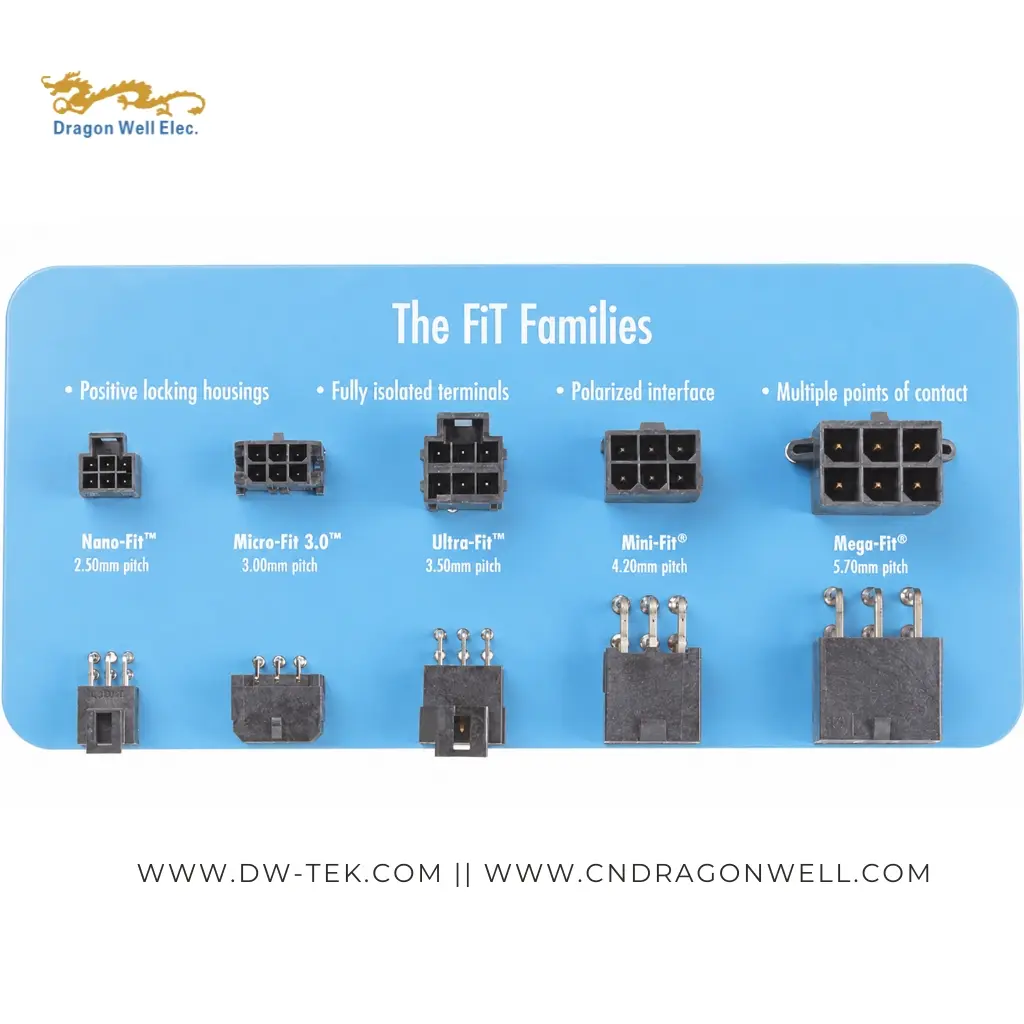
The image shows a FiT-style connector family display, including Nano-Fit™, Micro-Fit 3.0™, Ultra-Fit™, Mini-Fit®, and Mega-Fit® style connector solutions. These connector families are commonly associated with different pitch sizes, power levels, housing designs, and application requirements.
For engineers, sourcing teams, and OEM/ODM buyers, choosing the right Power Connector can improve electrical reliability, assembly efficiency, mechanical security, and long-term product stability. A good connector should support secure mating, correct orientation, stable contact, and suitable current performance for the target application.
What Is a Power Connector?
A Power Connector is an electrical connector used to transfer power between different parts of an electronic system. It may connect a wire harness to a PCB, one board to another board, or a power module to a control system.
In PCB module design, power connectors are often used for battery packs, power supplies, motor controllers, industrial devices, communication equipment, household appliances, automotive electronics, and smart hardware.
A well-designed connector should provide stable electrical contact, safe mating, reliable retention, and suitable performance under the expected operating conditions.
Why Power Connector Selection Matters
Selecting the correct Power Connector is critical because power delivery failures can cause serious product issues. Poor contact, weak locking, incorrect mating, or unsuitable current capacity may lead to voltage drop, overheating, intermittent power loss, or after-sales problems.
In many OEM projects, the connector becomes a key part of the product’s reliability. Even if the PCB design is correct, a weak connector can reduce the final product quality.
That is why engineers usually review pitch, current rating, voltage rating, housing design, terminal structure, material quality, mating force, locking function, and assembly method before finalizing a connector.
FiT Family Connector Overview
FiT-style connector families are commonly used for wire-to-board and power-related PCB applications. The image highlights several typical family styles:
| Connector Family | Pitch | Typical Design Position |
|---|---|---|
| Nano-Fit™ style | 2.50mm | Compact power connection |
| Micro-Fit 3.0™ style | 3.00mm | Balanced size and power |
| Ultra-Fit™ style | 3.50mm | Mid-power applications |
| Mini-Fit® style | 4.20mm | Widely used power connection |
| Mega-Fit® style | 5.70mm | Higher-power connection needs |
These connector types help engineers select a suitable Power Connector according to PCB space, current requirement, product structure, and assembly method.
The image also highlights four important connector design features:
- Positive locking housings
- Fully isolated terminals
- Polarized interface
- Multiple points of contact
These features are important because they help improve mating reliability, assembly accuracy, and electrical stability.
7 Powerful Advantages of FiT-Style Power Connectors
1. Reliable Power Delivery
The first major advantage of a good Power Connector is reliable power delivery. Electronic systems need stable current flow between power sources, PCBs, and functional modules.
A properly selected connector helps reduce contact instability and supports dependable operation during daily use. This is especially important for products that operate for long hours or handle repeated power cycles.
2. Positive Locking for Secure Mating
Positive locking is one of the most valuable features in power connector design. A locking structure helps keep the connector securely mated after assembly.
This reduces the risk of accidental disconnection caused by movement, vibration, handling, or cable tension. For industrial equipment, automotive electronics, household appliances, and communication devices, secure mating can directly improve product reliability.
3. Polarized Interface Reduces Assembly Errors
A polarized interface helps prevent incorrect mating direction. This is very important in production environments where many connectors may look similar.
When a Power Connector has a clear polarized design, operators can connect parts more accurately. This reduces assembly mistakes and helps protect the circuit from incorrect connection.
For OEM manufacturing, fewer assembly errors can improve production efficiency and reduce rework cost.
4. Fully Isolated Terminals Improve Protection
Fully isolated terminals help protect contacts and reduce the chance of terminal damage during handling and assembly. In compact PCB modules, terminal protection is important because exposed contacts may be easier to bend or misalign.
A connector with better terminal isolation can help improve durability and make the product easier to assemble safely.
5. Multiple Contact Points Support Stability
Multiple points of contact can improve electrical contact stability. In power delivery applications, stable contact is important because poor contact can create heat, resistance, and intermittent performance issues.
A strong contact system helps the connector maintain a reliable electrical path after mating. This is useful in products where stable power is essential.
6. Multiple Pitch Options for Design Flexibility
Different PCB modules need different connector sizes. A compact product may need a smaller pitch connector, while a higher-power system may require a larger connector.
FiT-style families provide several pitch options, allowing engineers to select a Power Connector based on available PCB space, power level, wire size, and product structure.
This flexibility supports better design optimization in both compact and high-power applications.
7. Suitable for OEM and ODM Customization
For OEM and ODM projects, connector consistency and customization are very important. A Power Connector may need specific pitch, circuit count, housing color, terminal plating, cable length, packaging type, or performance requirement.
FiT-style connector solutions are useful because they can support different product structures and power levels. This makes them suitable for long-term production, product line expansion, and application-specific design.
Common Applications of Power Connector Solutions
Consumer Electronics
Power connectors are widely used in smart home devices, display products, audio equipment, charging products, gaming accessories, and small electronic modules. A compact connector can help save PCB space while supporting stable power input.
Industrial Control Equipment
Industrial control systems often require dependable power connections for controllers, sensors, power boards, relays, communication modules, and motor-related equipment. A secure Power Connector can help reduce downtime and improve maintenance reliability.
Automotive and Mobility Electronics
Automotive and mobility products often require connectors that can handle vibration, temperature change, and long service life. Power connector selection should consider mechanical retention, material quality, current rating, and operating environment.
Communication Devices
Routers, gateways, base devices, network terminals, and communication modules often use PCB power connectors for internal power transfer. Stable contact performance is important because poor connection can affect device operation.
Power Supply and Battery Systems
Power supplies, battery packs, backup power devices, and energy-related modules need reliable connectors for power transfer. In these applications, current rating, voltage rating, contact resistance, and thermal performance should be reviewed carefully.
Engineering Insights for Connector Selection
Choosing the right Power Connector requires a full engineering review. The connector should match the electrical, mechanical, and environmental needs of the product.
First, engineers should check the current rating and voltage rating. The connector must support the actual power requirement with suitable safety margin.
Second, the pitch and circuit count must match the PCB layout and available space. Smaller pitch designs can save space, but they may require tighter design control.
Third, the mating structure should be reviewed. Positive locking, polarization, and contact protection can improve assembly reliability.
Fourth, engineers should check the wire size, terminal design, and crimping requirement. A good connector system depends on both the housing and the terminal connection quality.
Finally, the application environment matters. Temperature, vibration, humidity, repeated mating, and product life cycle all affect connector selection.
Key Design Factors to Check
Before finalizing a Power Connector for a PCB module or wire-to-board application, engineers should review:
- pitch size
- circuit number
- current rating
- voltage rating
- wire gauge range
- terminal material
- contact plating
- housing material
- operating temperature
- locking structure
- polarization design
- mating force
- PCB footprint
- packaging method
- production volume requirement
These factors help reduce design risk and support better long-term product reliability.
Why Work with Dragon Well Electronics
Dragon Well Electronics supports connector and interconnect solutions for consumer electronics, industrial products, communication devices, automotive electronics, PCB modules, and OEM/ODM hardware projects.
For Power Connector projects, we can support:
- wire-to-board connector solutions
- PCB power connector alternatives
- FiT-style connector application support
- custom connector evaluation
- OEM and ODM project cooperation
- engineering communication for product development
- stable production and long-term supply support
If your project involves power delivery, PCB module connection, wire-to-board interconnects, battery systems, industrial control equipment, or custom electronic assemblies, Dragon Well Electronics can support reliable connector solutions for your application.
Order and RFQ
Need support for power connectors, FiT-style connector alternatives, wire-to-board connectors, PCB power connectors, or custom connector solutions for OEM electronics?
Please share your application, required specification, pitch, circuit count, current rating, wire size, mounting style, housing requirement, terminal plating, packaging method, and project details for evaluation.
Websites:
www.dw-tek.com
www.cndragonwell.com
Email:
prothick@cndragonwell.com || info@dw-tek.com
Connect with Us
LinkedIn: https://www.linkedin.com/company/dragon-well-electronics-co-ltd
Instagram: https://www.instagram.com/dragonwell_electronics
Facebook: https://www.facebook.com/DragonWellElectronics