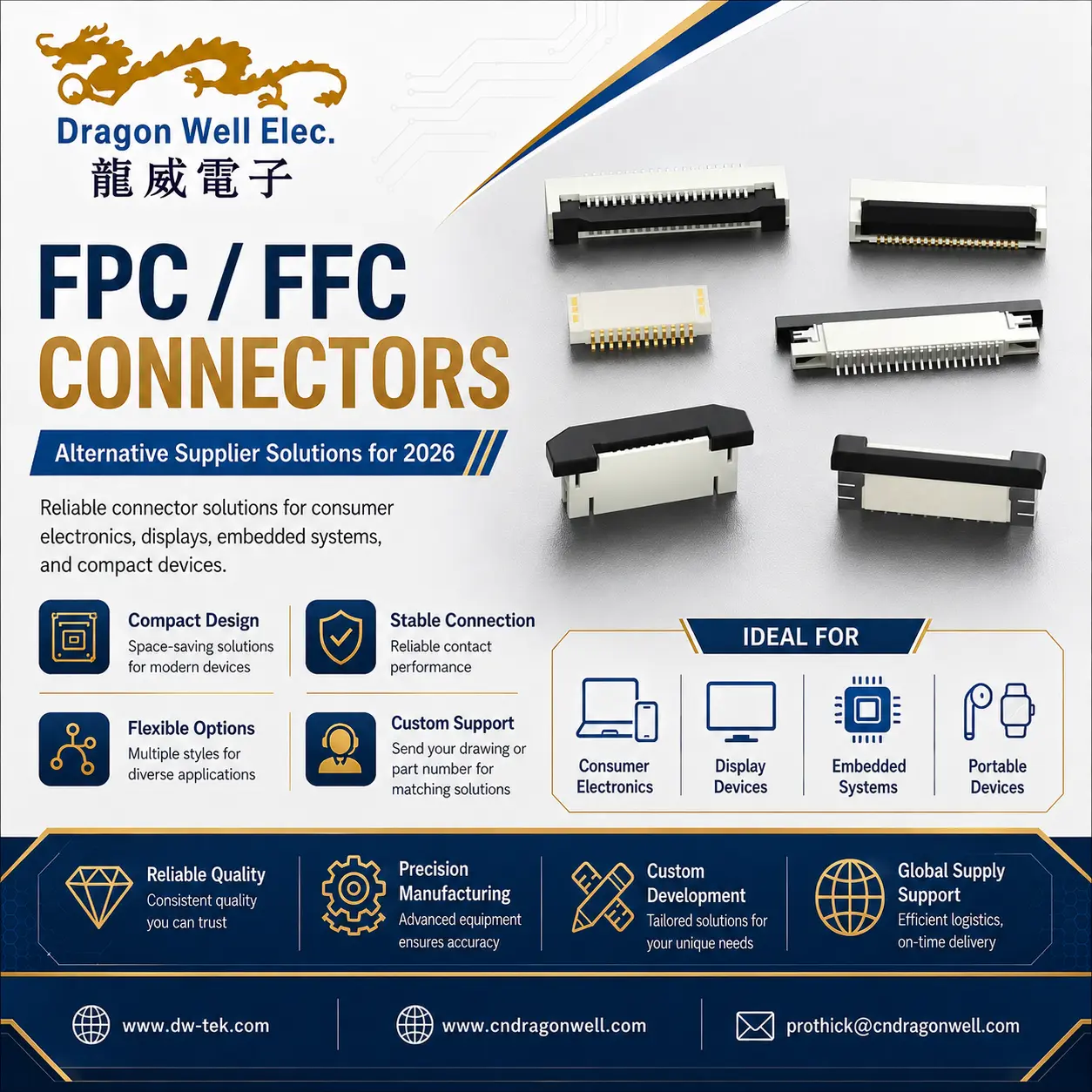
The FPC FFC connector is widely used in compact electronic products where space-saving design, flexible cable routing, and reliable electrical connections are important. From consumer electronics and display devices to embedded systems and portable equipment, these connectors provide a practical way to connect flexible circuits or flat cables to printed circuit boards.
For purchasing teams, engineers, OEMs, and ODM companies, finding a reliable alternative supplier has also become an important part of connector sourcing. An alternative source can provide greater sourcing flexibility, technical support, customization options, and additional supply security.
However, selecting an FPC FFC connector alternative should not be based on appearance or price alone. Pitch, pin count, cable thickness, contact position, mounting style, connector dimensions, and application requirements should all be checked before approving a replacement.
What Is an FPC FFC Connector?
An FPC FFC connector is designed to connect a Flexible Printed Circuit (FPC) or Flat Flexible Cable (FFC) to a PCB or another electronic interface.
These connectors are commonly selected when conventional wire-to-board connections would take up too much space. Their compact structure makes them particularly useful in modern electronic devices where PCB space and product height are limited.
FPC and FFC connector families are available in different configurations, including different pitches, circuit counts, mounting orientations, contact positions, and locking styles. Major connector manufacturers such as Molex and TE Connectivity also offer multiple FFC/FPC connector configurations for compact cable-to-board applications.
Because there are many possible configurations, buyers should always compare the complete specifications before choosing an alternative.
Why Alternative Suppliers Matter in 2026
Connector sourcing is no longer only about finding the lowest price. Manufacturers increasingly need suppliers that can support product compatibility, stable manufacturing, project communication, customization, and long-term supply requirements.
A qualified alternative FPC connector supplier can provide an additional sourcing option without necessarily replacing the existing supplier.
This can be useful when companies need:
- A second-source option
- Additional production capacity
- More flexible quantities
- Technical matching support
- Customized connector development
- Competitive sourcing options
- Improved supply flexibility
For an FPC FFC connector, alternative sourcing should always begin with technical comparison. Even connectors with the same pitch and pin count may differ in height, cable thickness, contact direction, locking mechanism, or PCB footprint.
7 Key Checks When Choosing an Alternative Supplier
1. Confirm Connector Pitch and Pin Count
Pitch and pin count are among the first specifications to compare.
An alternative connector should match the circuit requirements of the existing design. Depending on the application, different FPC/FFC connector families may use different pitch sizes and numbers of positions.
Pitch alone, however, does not confirm full compatibility.
2. Check FPC or FFC Cable Compatibility
The flexible cable or circuit must match the connector interface.
Important points can include:
- FPC or FFC thickness
- Cable width
- Exposed contact area
- Contact position
- Insertion direction
These details should be compared with the drawing or datasheet of the proposed FPC FFC connector before approval.
3. Review Contact and Locking Style
Different connector designs use different mating and locking mechanisms.
Depending on the product, these can include ZIF, non-ZIF, flip-lock, slider, or other actuator designs. For example, commercial FFC/FPC product families include both ZIF and non-ZIF configurations.
The correct design depends on the assembly process and application requirements.
4. Verify PCB Mounting and Dimensions
An alternative FPC connector must fit the existing PCB and product structure.
Check:
- Right-angle or vertical orientation
- Surface-mount or through-hole mounting
- Connector height
- Overall dimensions
- PCB footprint
- Hold-down structure
Small dimensional differences can affect PCB assembly or mechanical installation.
5. Compare Electrical Requirements
Electrical specifications should also match the application.
Depending on the project, buyers may need to check current rating, voltage rating, contact resistance, insulation resistance, and withstand voltage.
These values should always come from the specification or engineering drawing of the exact connector being evaluated rather than being assumed from a similar product.
6. Evaluate Manufacturing Quality
Reliable contact performance depends on consistent connector manufacturing.
For an FPC FFC connector, terminal positioning, housing dimensions, contact quality, material selection, plating, and assembly consistency can influence long-term connection performance.
Samples should be tested with the actual PCB and FPC/FFC whenever possible before a replacement enters mass production.
7. Check Custom and Supply Support
A capable alternative supplier should support more than standard catalogue products.
For OEM and ODM projects, useful supplier support can include:
- Drawing review
- Part-number matching
- Sample support
- Custom connector development
- Production-volume support
- Technical communication
- International logistics
This is especially useful when a standard connector cannot completely meet the project’s mechanical or application requirements.
Common FPC FFC Connector Applications
The compact structure of the FPC FFC connector makes it suitable for many electronic products.
Consumer Electronics
FPC and FFC connections are commonly used in compact consumer products to connect displays, control boards, cameras, sensors, and other internal modules.
Display Devices
Displays often require flexible connections between the screen, control electronics, and main PCB. An FPC FFC connector can provide a compact interface while helping reduce internal wiring space.
Embedded Systems
Embedded controllers and compact electronic systems may use flexible circuits where space-saving PCB connections are required.
Portable Devices
Portable electronics often require lightweight and low-profile components. FPC connector families are specifically available in low-profile configurations for space-constrained electronic designs.
Other applications can include communication equipment, control panels, cameras, smart devices, and compact industrial electronics.
How to Choose the Right FPC FFC Connector
Choosing the correct FPC FFC connector starts with understanding the actual application.
First, identify the pitch and required circuit count.
Next, confirm the FPC or FFC thickness, contact side, and insertion direction.
Then review the mounting orientation, connector height, PCB footprint, and locking mechanism.
Finally, compare the electrical, environmental, and material requirements with the proposed connector specification.
If you are searching for an alternative to an existing connector, providing the original part number and drawing is usually the most effective starting point. This allows the supplier to compare the complete interface rather than relying only on photographs.
Why Connector Quality Matters
A compact connector may be a small component inside an electronic system, but unstable contact can affect the performance of the entire product.
Reliable FPC FFC connector manufacturing requires consistent dimensions, stable terminal positioning, appropriate materials, and controlled production processes.
For OEM and ODM projects, quality consistency becomes especially important when connectors are produced in larger quantities or used across long production cycles.
A dependable supplier should therefore support both technical matching and stable manufacturing rather than focusing only on price.
Why Consider Dragon Well Electronics as an Alternative Supplier?
Dragon Well Electronics currently offers an online range of FPC connector solutions that includes different pitch, orientation, contact, and actuator configurations.
Its current product range includes examples such as 0.3 mm and 0.5 mm FPC connector families, back-flip designs, vertical designs, bottom-contact products, and right-angle SMT options.
Buyers can review the main Dragon Well FPC Connectors category or individual products such as:
- 0.5 mm FPC Connector, Bottom Contact, SMT, 4–50 Pin
- 0.5 mm Back-Flip FPC Connector, Right-Angle SMT
- 0.5 mm 20-Pin Right-Angle FPC Connector
- 0.50 mm Pitch Vertical 30-Pin FPC Connector
For sourcing teams evaluating an FPC FFC connector alternative supplier, Dragon Well can review an existing part number or customer drawing to determine whether an available product or a customized solution should be considered.
Potential project support includes:
- FPC/FFC connector selection
- Alternative-part matching
- Drawing review
- Sample support
- Customized connector development
- OEM/ODM project support
- Production coordination
- Global supply support
Rather than selecting an alternative solely on price, buyers can send the existing connector information for a technical comparison first.
Order and RFQ
Need an FPC FFC connector alternative, second-source option, or support matching an existing FPC/FFC connector?
Please share your current part number, engineering drawing, pitch, pin count, FPC/FFC thickness, application, required specifications, and estimated quantity for evaluation.
Dragon Well Electronics can review the requirement and help identify a suitable standard or customized connector solution.
Websites:
www.dw-tek.com
www.cndragonwell.com
Email:
prothick@cndragonwell.com || info@dw-tek.com
Connect with Us
LinkedIn: Dragon Well Electronics Co., Ltd.
Instagram: Dragon Well Electronics
Facebook: Dragon Well Electronics